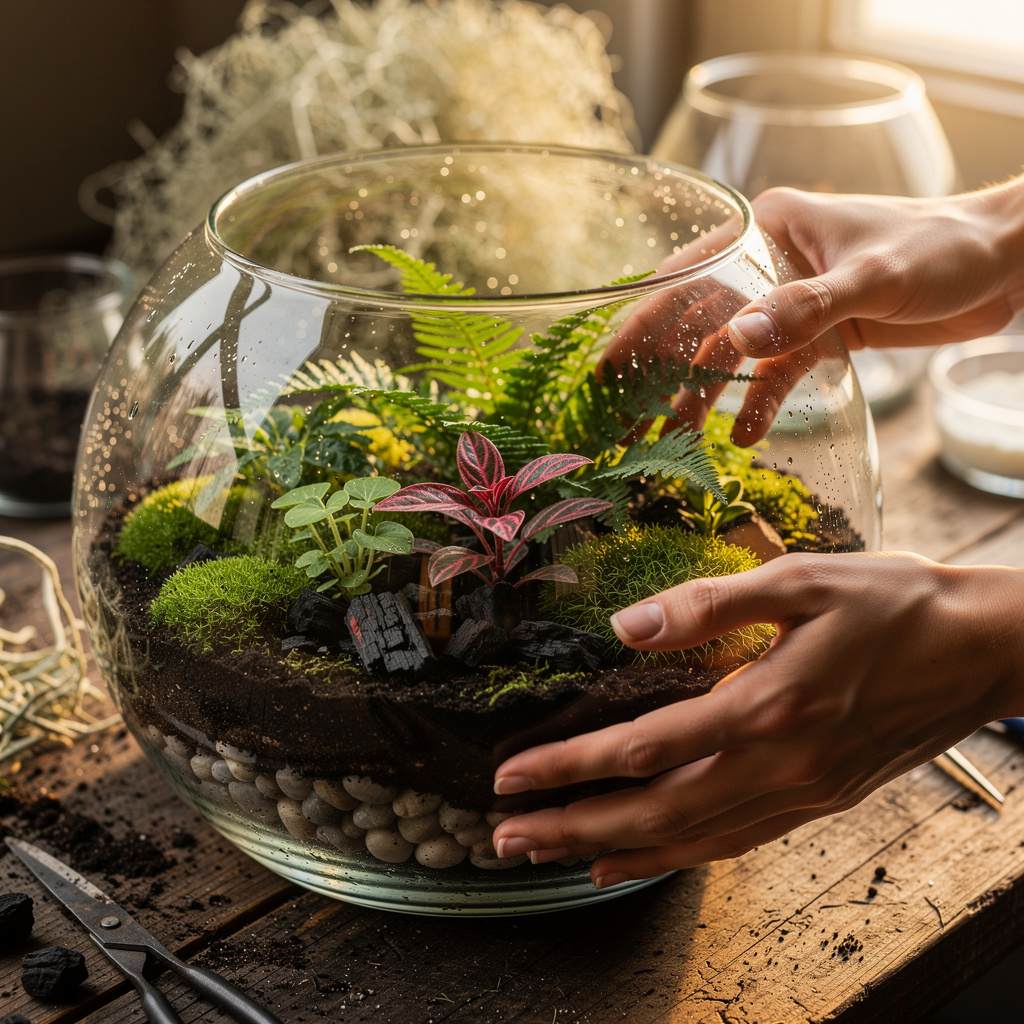
What is Terrarium Design and Closed Ecosystems?
Terrarium Design and Closed Ecosystems Training
This Terrarium Design and Closed Ecosystems certificate program is a comprehensive journey into the art and science of building self-sustaining miniature worlds. Designed for hobbyists, interior designers, educators, and anyone captivated by the intersection of nature and design, the course guides you from foundational ecological principles to the hands-on creation of thriving closed terrariums. You will master substrate layering, plant compatibility, hardscape construction, and environmental control, culminating in the ability to design, assemble, and maintain your own balanced ecosystems that can flourish for years with minimal intervention.
The program is structured as a progressive, beginner-friendly pathway that balances scientific theory with intensive practical application. Starting with the science of closed ecosystems and essential materials, you move through plant selection, foundational hardscaping, and your first full assembly, then advance into lighting, routine care, and troubleshooting. The curriculum builds four core skill areas—ecosystem dynamics, horticultural technique, aesthetic design, and long-term stewardship—before exploring advanced techniques, specialized vivariums, and even display and photography. With the rising demand for biophilic design and sustainable living practices, this training offers a timely opportunity to turn a rewarding hobby into a marketable skill set or a deeper personal practice.
What is Terrarium Design and Closed Ecosystems?
Terrarium design and closed ecosystems represent the practice of creating sealed or semi-sealed glass environments where plants, substrate, water, and microfauna interact in a self-regulating cycle. At its core, the subject merges botany, ecology, and design to replicate natural water and nutrient cycles on a miniature scale—condensation, photosynthesis, and decomposition all occur within a transparent vessel. It covers everything from tropical mossariums and arid desertscapes to complex paludariums that incorporate aquatic and terrestrial zones, with a strong emphasis on understanding how light, humidity, and biological selection determine the longevity of the system.
In today’s world, closed ecosystems have moved far beyond a niche hobby. They are central to biophilic interior design, used in corporate spaces, healthcare environments, and urban residences to reduce stress and improve air quality. Educational institutions employ them as living models of ecological literacy, while a growing community of artists and makers pushes the boundaries of terrarium aesthetics through social media and exhibitions. Recent shifts toward sustainable, low-maintenance greenery have also made closed terrariums a preferred alternative to traditional houseplants, as they require dramatically less water and care once established.
Mastering this subject builds a unique skill stack that bridges scientific observation with creative expression. You develop a working knowledge of soil microbiology, plant physiology, and microclimate control, alongside an eye for composition, scale, and naturalistic storytelling. These competencies are invaluable for professionals in landscape architecture, environmental education, and retail horticulture, as well as for individuals seeking a meditative, hands-on connection to nature. Whether you aim to craft living art, teach ecological concepts, or simply cultivate a serene green corner at home, terrarium design offers a profound way to engage with the resilience and beauty of the natural world.
What Will This Course Bring You?
- Analyze the water, carbon, and nutrient cycles within a sealed terrarium to predict long-term ecosystem stability.
- Select appropriate glass vessels, substrates, and tools based on the desired terrarium type and scale.
- Evaluate plant species for compatibility in terms of light, humidity, and growth habits to create a harmonious closed environment.
- Construct a functional drainage layer and substrate profile using layered materials to prevent root rot and support plant health.
- Implement artificial lighting and ventilation strategies to maintain optimal temperature, humidity, and photoperiod for a closed ecosystem.
- Perform routine pruning, cleaning, and moisture adjustments to sustain a healthy terrarium without disrupting the microclimate.
- Diagnose and resolve common issues such as mold, algae, or plant decline by adjusting environmental factors.
- Introduce and manage microfauna like springtails and isopods to establish a self-sustaining clean-up crew within the ecosystem.
Curriculum
12 Units1. The Science of Closed Ecosystems
30 min
2. Essential Materials and Tools
30 min
3. Plant Selection and Compatibility
30 min
4. Substrate Layering and Hardscape Foundations
30 min
5. Assembling Your First Terrarium
30 min
6. Lighting and Environmental Control
30 min
7. Routine Maintenance and Pruning
30 min
8. Troubleshooting Common Problems
30 min
9. Closed Ecosystem Dynamics and Microfauna
30 min
10. Advanced Terrarium Design Techniques
30 min
11. Specialized Terrariums and Vivariums
30 min
12. Display, Photography, and Community
30 min
Exam – Terrarium Design and Closed Ecosystems
20 Questions • 70% Pass • 30 min
Unlock All Units for Free
Create an account, enroll in the course, and start with the first unit right away.
Exam – Terrarium Design and Closed Ecosystems
20 Questions • Pass: 70% • 30 min
Course Duration
360
Total Minutes
12
Unit
1
Final Exam
~30
Min / Unit
Terrarium Design and Closed Ecosystems Certificate Program
Document Your Skill
Those who pass the 20-question, 30-minute exam with 70% receive the Terrarium Design and Closed Ecosystems Certificate.
Stand Out on Your CV
By adding your certificate to your CV, gain a professional reference in job applications and stand out from the crowd.
Career Advantage
Catch Wisdom certificates are recognized by HR departments and increase career opportunities.
CERTIFICATE FEE
At the end of the course, an online exam consisting of 20 questions with a 30-minute time limit is given. The exam appears automatically after you complete the topics. Anyone who scores at least 70 out of 100 on the certificate exam is awarded the Terrarium Design and Closed Ecosystems Document (certificate of attendance). You can add the certificate you earn to your CV for job applications in the many sectors listed above, and use it as a reference proving that you took this interactive course.
The Certificate of Achievement you receive with the Terrarium Design and Closed Ecosystems course program holds value that proves your personal and professional development in the business world. By adding it to your CV, it can serve as an important reference in your job applications. Moreover, compared with certificates from other private training institutions, Catch Wisdom certificates are offered to our participants at a much more affordable price.
Because HR departments recognize Catch Wisdom as a reputable institution in this field, they value these certificates and may evaluate your job applications favorably. For this reason, a Terrarium Design and Closed Ecosystems course certificate from Catch Wisdom can make your applications more attractive and place you in an advantageous position in the business world.
For more information, we recommend visiting the Support page.
Certificate in 7 Languages
Earning success certificates from our courses is now more meaningful and global. With certificates available in Turkish, English, German, French, Spanish, Arabic, and Russian, we fully unlock the potential of students worldwide.
Why Certificate in 7 Languages?
-
01
Global Skill Development
Receiving your certificates in 7 different languages strengthens your communication skills as you engage with more people worldwide. It lets you operate more confidently and capably on the international stage.
-
02
International Job Opportunities
Employers may see your certificates in multiple languages as a sign of your ability to seize global opportunities. You can open more doors to new jobs and projects.
-
03
Cultural Richness
The chance to earn certificates in different languages helps you build closer ties with various cultures and broadens your worldview. It enriches your global perspective and deepens cultural understanding.
-
04
Ability to Participate in International Projects
Multilingual certificates give you an edge to work more effectively on international projects. They boost your chances of leadership and participation in diverse projects in the business world.
-
05
Prove Yourself on the Global Stage
Certificates in multiple languages let you showcase your skills and knowledge worldwide. You can become an internationally recognized professional.
Language diversity opens worldwide opportunities. If you want to prove yourself in the international arena, join our online Terrarium Design and Closed Ecosystems course program and begin this journey with us.
Frequently Asked Questions (FAQ)
Is this course paid?
How do I join the course?
Can I take the course at my own pace?
How can I get my certificate?
What are the advantages of the Certified Certificate?
Boost Your Career
Take a new career step with the Terrarium Design and Closed Ecosystems course. Add your certificate to your CV, stand out in job applications, and open the door to new opportunities in the industry.
StartStudent Reviews
No reviews yet
Enroll in this course and be the first to leave a review about your experience with Terrarium Design and Closed Ecosystems.
Start