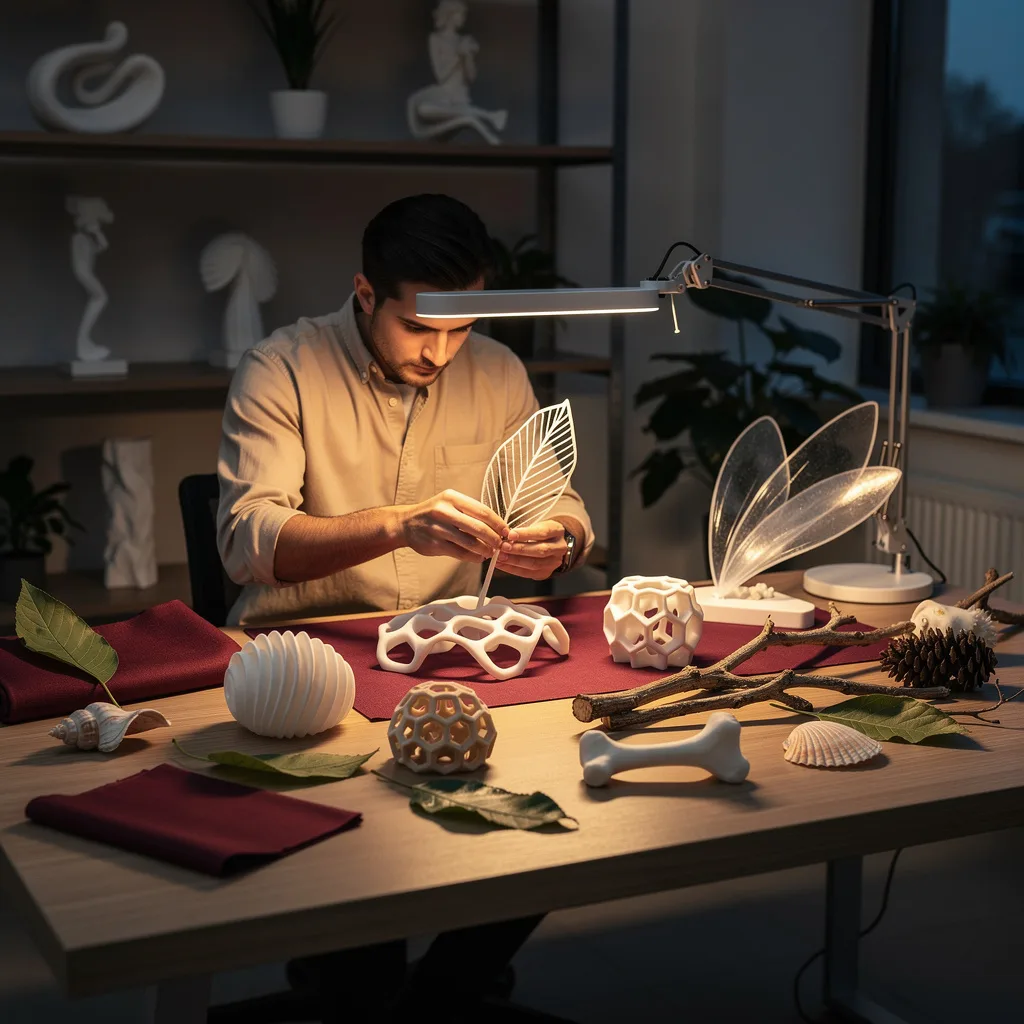
What is Biomimicry Design Principles?
Biomimicry Design Principles Training
Biomimicry Design Principles certificate program offers a comprehensive exploration of nature-inspired innovation methodologies that are reshaping sustainable design across industries. This training equips you with the philosophical foundations, systematic methodologies, and practical frameworks needed to translate biological strategies into human design solutions. Whether you are an architect, engineer, product designer, sustainability consultant, or innovator seeking regenerative approaches, this program provides the essential toolkit for emulating nature's time-tested patterns to solve complex design challenges.
The course bridges biology, systems thinking, and design methodology to teach you how organisms, behaviors, and ecosystems have solved problems over 3.8 billion years of evolution. You will learn to move beyond superficial aesthetic mimicry to understand functional design principles that drive truly sustainable innovation. The training is designed for professionals who want to integrate ecological wisdom into their work and contribute to a regenerative future where human systems function in harmony with natural systems.
What is Biomimicry Design Principles?
Biomimicry Design Principles represent an interdisciplinary approach to innovation that consciously emulates nature's genius to solve human design challenges. Popularized by biologist Janine Benyus in her 1997 book Biomimicry: Innovation Inspired by Nature, this methodology recognizes that living organisms have already solved many of the problems humans grapple with—energy efficiency, thermal regulation, structural optimization, waste elimination, and resilient adaptation. Rather than harvesting or domesticating nature, biomimicry consults the natural world as a mentor, model, and measure, translating biological forms, processes, and ecosystems into sustainable design strategies.
The practice operates across three fundamental levels: organism-level biomimicry that emulates specific biological forms and structures; behavior-level biomimicry that replicates how organisms respond to environmental conditions; and ecosystem-level biomimicry that mirrors the interconnected relationships and resource flows within natural communities. This multi-scalar approach enables designers to tackle challenges from material composition to systemic complexity. Modern relevance has grown exponentially as industries confront climate imperatives, resource scarcity, and the urgent need to transition from linear "take-make-waste" models to circular, life-supporting systems. Biomimicry provides a scientifically grounded pathway to create products, buildings, and systems that are inherently sustainable because they function like living things.
At its core, biomimicry integrates two primary design frameworks: "Biology to Design," where observation of natural models sparks innovation, and "Challenge to Biology," where specific human problems are reframed to find analogous biological solutions. Both pathways follow the four-stage Biomimicry Thinking process—Discover, Explore, Create, and Evaluate—using Life's Principles as ethical and functional benchmarks. These principles, distilled from patterns observed across the living world, include strategies like optimizing rather than maximizing, using benign manufacturing processes, and designing for decomposition. By embedding these ecological standards into the design process, biomimicry practitioners develop solutions that are not only efficient and elegant but also regenerative by design.
What Will This Course Bring You?
- You will learn to articulate the ethical and philosophical foundations of biomimicry as a design discipline, distinguishing between superficial bio-inspiration and functional biomimicry grounded in biological principles.
- You will master the three levels of biomimicry application—organism, behavior, and ecosystem—enabling you to select the appropriate level of biological abstraction for any given design challenge.
- You will acquire systems thinking methodologies for analyzing biological complexity, identifying feedback loops, self-organization patterns, and emergent properties that translate into resilient human systems.
- You will develop the ability to extract and abstract design principles from biological strategies using the AskNature database and functional classification frameworks, translating "how nature does X" into actionable design patterns.
- You will learn to implement the Biomimicry Deep Dive Process through all four stages: discovering natural models, exploring functional contexts, creating design solutions, and evaluating outcomes against Life's Principles.
- You will gain expertise in analyzing natural materials and structural configurations—such as hierarchical composites, gradient structures, and optimized geometries—to inform lightweight, high-performance material selection and structural design.
- You will master energy efficiency strategies derived from biological thermodynamics, including passive heating and cooling, distributed energy storage, and minimizing dissipation through biomimetic approaches.
- You will learn to design circular systems that eliminate waste entirely by modeling nutrient cycling, cradle-to-cradle material flows, and symbiotic industrial ecologies found in natural environments.
- You will acquire techniques for embedding adaptation and resilience into designs, studying how organisms respond to changing conditions and translating those strategies into flexible, responsive systems.
- You will understand fluid dynamics principles from nature—such as the Reynolds number optimization, surface tension manipulation, and drag reduction strategies—to design efficient water management and transport systems.
- You will learn to apply symbiotic and collaborative strategies observed in mutualistic relationships, developing designs that foster cooperation, resource sharing, and positive-sum interactions between system components.
- You will synthesize all competencies through applied projects, demonstrating the ability to move from biological research to validated design concepts using evidence-based biomimicry methodology.
Curriculum
12 Units1. Foundations and Philosophy of Biomimicry
30 min
2. Levels of Biomimicry
30 min
3. Biological Systems Thinking
30 min
4. Natural Strategies and Design Patterns
30 min
5. The Biomimicry Deep Dive Process
30 min
6. Materials and Structural Design
30 min
7. Energy Strategies and Thermodynamics
30 min
8. Circular Systems and Zero-Waste Design
30 min
9. Adaptation and Resilience
30 min
10. Water Management and Fluid Dynamics
30 min
11. Symbiosis and Collaborative Strategies
30 min
12. Applied Biomimicry Design
30 min
Exam – Biomimicry Design Principles
20 Questions • 70% Pass • 30 min
Unlock All Units for Free
Create an account, enroll in the course, and start with the first unit right away.
Exam – Biomimicry Design Principles
20 Questions • Pass: 70% • 30 min
Course Duration
360
Total Minutes
12
Unit
1
Final Exam
~30
Min / Unit
Biomimicry Design Principles Certificate Program
Document Your Skill
Those who pass the 20-question, 30-minute exam with 70% receive the Biomimicry Design Principles Certificate.
Stand Out on Your CV
By adding your certificate to your CV, gain a professional reference in job applications and stand out from the crowd.
Career Advantage
Catch Wisdom certificates are recognized by HR departments and increase career opportunities.
CERTIFICATE FEE
At the end of the course, an online exam consisting of 20 questions with a 30-minute time limit is given. The exam appears automatically after you complete the topics. Anyone who scores at least 70 out of 100 on the certificate exam is awarded the Biomimicry Design Principles Document (certificate of attendance). You can add the certificate you earn to your CV for job applications in the many sectors listed above, and use it as a reference proving that you took this interactive course.
The Certificate of Achievement you receive with the Biomimicry Design Principles course program holds value that proves your personal and professional development in the business world. By adding it to your CV, it can serve as an important reference in your job applications. Moreover, compared with certificates from other private training institutions, Catch Wisdom certificates are offered to our participants at a much more affordable price.
Because HR departments recognize Catch Wisdom as a reputable institution in this field, they value these certificates and may evaluate your job applications favorably. For this reason, a Biomimicry Design Principles course certificate from Catch Wisdom can make your applications more attractive and place you in an advantageous position in the business world.
For more information, we recommend visiting the Support page.
Certificate in 7 Languages
Earning success certificates from our courses is now more meaningful and global. With certificates available in Turkish, English, German, French, Spanish, Arabic, and Russian, we fully unlock the potential of students worldwide.
Why Certificate in 7 Languages?
-
01
Global Skill Development
Receiving your certificates in 7 different languages strengthens your communication skills as you engage with more people worldwide. It lets you operate more confidently and capably on the international stage.
-
02
International Job Opportunities
Employers may see your certificates in multiple languages as a sign of your ability to seize global opportunities. You can open more doors to new jobs and projects.
-
03
Cultural Richness
The chance to earn certificates in different languages helps you build closer ties with various cultures and broadens your worldview. It enriches your global perspective and deepens cultural understanding.
-
04
Ability to Participate in International Projects
Multilingual certificates give you an edge to work more effectively on international projects. They boost your chances of leadership and participation in diverse projects in the business world.
-
05
Prove Yourself on the Global Stage
Certificates in multiple languages let you showcase your skills and knowledge worldwide. You can become an internationally recognized professional.
Language diversity opens worldwide opportunities. If you want to prove yourself in the international arena, join our online Biomimicry Design Principles course program and begin this journey with us.
Frequently Asked Questions (FAQ)
Is this course paid?
How do I join the course?
Can I take the course at my own pace?
How can I get my certificate?
What are the advantages of the Certified Certificate?
Boost Your Career
Take a new career step with the Biomimicry Design Principles course. Add your certificate to your CV, stand out in job applications, and open the door to new opportunities in the industry.
StartStudent Reviews
No reviews yet
Enroll in this course and be the first to leave a review about your experience with Biomimicry Design Principles.
Start